blog
The Academies of Loudoun “Funk It” Team Showcases an Innovative Future Workforce


It started with a simple assignment: find something that bugs people. Four students at the Academies of Loudoun, Ridhi, Brynn, Anvita, and Myra were asked to interview friends, family members, and others in the community about the everyday problems they encounter. One answer was particularly familiar to the four student-athletes: sports bags stink. Practices and games meant sweaty clothes and equipment stuffed into bags, where the smell only got worse over time. It wasn’t a monumental problem, but it was real, relatable, and, they believed, solvable.
The earliest version of their solution didn’t yet look much like the colorful product they would eventually carry to competitions. Initially called Sentivol, the concept focused primarily on function: create something that could go inside a sports bag, eliminate unwanted odors, and replace them with a better scent. Then a friend suggested a decidedly less corporate name, Funk Off. “At first everyone was like, ‘No, that’s silly. We can’t do that,'” the team recalled. But the more they thought about it, the more they realized that being a little silly might actually be an advantage. The name was funny, memorable, and sounded like something their audience might actually buy.
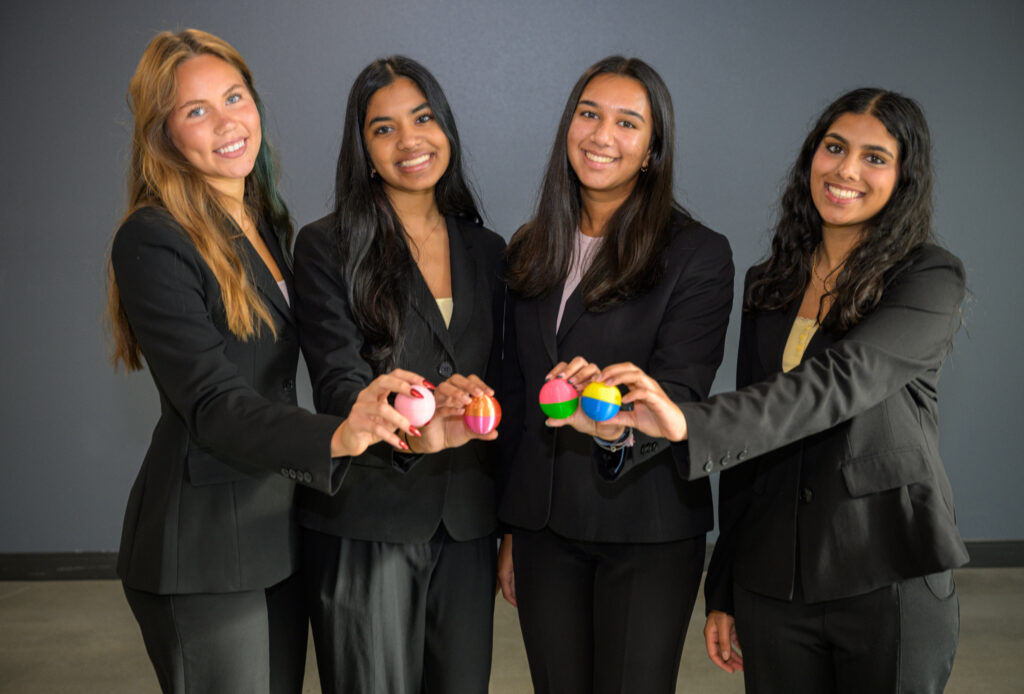
A trademark issue eventually sent the team back to the drawing board, and Funk Off became Funk It, but the personality stuck. The team began thinking beyond the function of the product to consider why someone would choose theirs over the alternatives. “We knew that we couldn’t just focus on the functionality,” they said. “We had to differentiate ourselves from the competition in some way.” That meant colorful, interchangeable containers, customizable combinations, and scent names built around pop culture and wordplay, including Pine and Prejudice, The Grape Gatsby, Pineapple Bottom Jeans, and Cynthia Erivanilla. The jokes were fun, but there was a business strategy behind them: Funk It needed to stand out in a crowded market and connect with the customers they understood best.
Building for a Customer They Knew
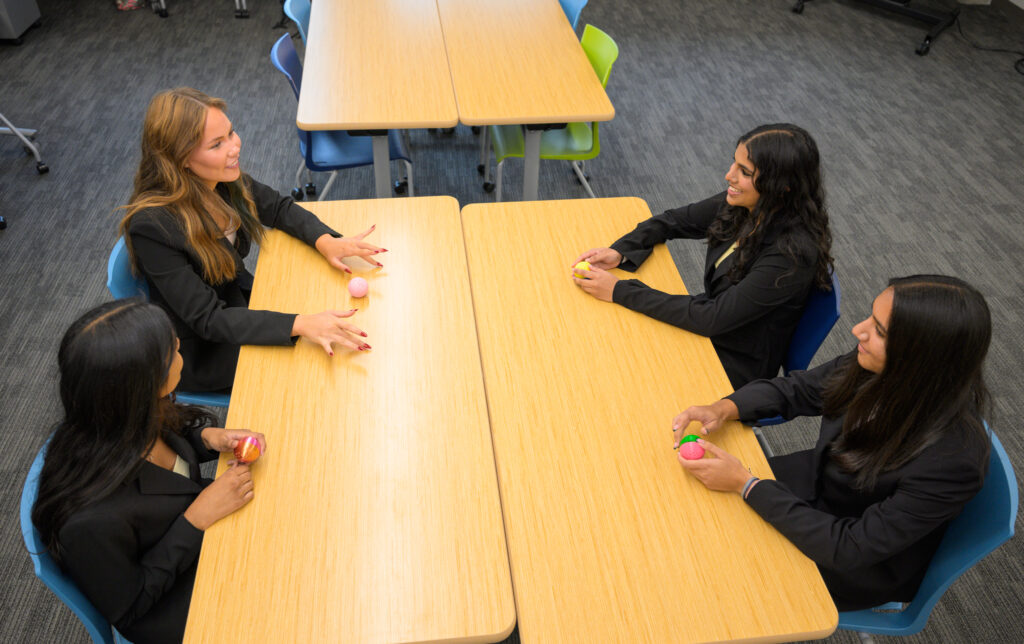
As the students researched similar products, they noticed that many sports products were marketed primarily toward boys and men, while others were designed to be neutral, with female athletes seemingly considered later. As four young women who played sports themselves, they saw an opportunity to approach Funk It differently. “We wanted to make a product that was completely catered to women,” the team said. That didn’t mean boys couldn’t use it. The team envisioned colors and scents with broad appeal, but they wanted young female athletes to encounter a sports product that felt as though it had been created with them in mind from the beginning.
That perspective influenced everything from the colors and scents to the customization and voice of the brand. It also gave the students something every business needs: a clearly defined customer. In this case, they didn’t have to imagine what that customer wanted because they were part of the market themselves. Their own experiences could help shape the product, but they didn’t stop there. They interviewed classmates and friends, tested assumptions, and asked other students what they valued. The process moved Funk It from something the four personally liked to something designed around what potential customers were telling them.
That same process of questioning followed them into the Academies’ makerspace, where an idea on paper had to become something they could actually hold. When the team first arrived, their concept was still loose, and makerspace staff challenged them to explain exactly what they intended to make and why it was worth making. Then came a deceptively simple question: What makes your product novel?
“We did not know what to say.”
Finding an answer pushed the team further. They began designing the Funk It container using CAD software, producing prototypes on a 3D printer, evaluating the results, adjusting dimensions, and printing again. The contents presented a different challenge. Making a gym bag smell like vanilla was relatively easy; removing the odor already there was harder. Research led them to activated charcoal, while mentors connected them with people who understood scent and chemistry. They learned about zinc oxide and experimented with waxes, fragrances, and different formulations. What had started as an entrepreneurship assignment was suddenly requiring elements of product design, manufacturing, chemistry, customer research, and marketing.
Learning What It Takes to Build a Business
Then came the financials. Like many first-time entrepreneurs, the students discovered that having a good idea and figuring out how to make it didn’t necessarily mean they knew what it would take to build a viable company around it. As they worked through manufacturing, startup, and operating costs, their projected investment climbed past $100,000. “We so underestimated how much money it actually was to start up a business,” the team recalled.
That realization was part of what made the project different from simply studying entrepreneurship from a textbook. The students had to confront the tradeoffs and practical questions that come with trying to bring a product to market. Each took on different responsibilities spanning operations, communications, finance, and overall management, but the roles were never completely separate. “We all kind of collaborated on everything,” they said. Over the course of the project, they learned when to divide responsibilities, when to lean on someone’s particular strength, and when the team needed to come back together. With limited classroom time and competition deadlines approaching, collaboration and time management became just as important as the product itself.
The experience also extended well beyond the four-person team. Teachers challenged their thinking, makerspace staff helped turn an idea into a physical prototype, mentors connected them with technical expertise, and business professionals and competition judges questioned their assumptions. Their mentor Ramona helped connect the students with expertise in chemistry and scent development, while other entrepreneurs helped them think more critically about their business and presentation. Among them was KIND Snacks founder and “Shark Tank” guest Shark Daniel Lubetzky, who helped the team refine its competition pitch and immediately understood the problem Funk It was trying to solve because his own daughter played sports.
Those connections exposed the students to something that can be difficult to replicate in a classroom: the experience of having an idea challenged by people with real-world expertise and then figuring out what to do with their feedback. It also began to change the way the students viewed the accomplished business leaders they were meeting. People who had once seemed intimidating from a distance became mentors, judges, and conversations.
“Before we actually were talking to them personally, it seemed like they were billionaires, and it was some scary thing, but then actually talking to them and realizing that they’re people just like us … it made us think that that was achievable.”
Finding Their Voice
That growing confidence was especially evident when it came time to present. In Entrepreneurship I, the students learned early that public speaking would be a regular part of the program. One teacher even tracked filler words such as “um” and “like” during presentations. For students who weren’t accustomed to speaking in front of a room, the experience could initially be intimidating, but the presentations kept coming. They practiced explaining ideas, responding to questions, and becoming comfortable enough with their material to focus less on the act of presenting and more on the story they wanted to tell.
By the time the Funk It team reached its final competition pitch, the setting had grown from a classroom to an auditorium, but their confidence had grown with it. “We were so excited to actually tell people about something that we’re proud of,” the partners said. Their work ultimately earned first place and helped take the students to Chicago, where they introduced Funk It to people from across the country. Instead of delivering one formal presentation to a panel of judges, they repeatedly found themselves explaining the product to strangers walking through a room filled with student businesses. Soon, they were striking up conversations based on the state listed on someone’s lanyard and discovering that no matter where people were from, many immediately understood the problem Funk It was designed to solve.
For the students, the change was striking. The same young women who remembered being nervous about presenting were now actively approaching strangers to talk about something they had created. That experience is also reflected in the advice they would give students following behind them. Choose a problem you genuinely care about. Don’t be intimidated by speaking. Learn how to tell a story. Talk to people about your idea, listen to what they tell you, and be excited about what you’re building.
Those lessons are already influencing how members of the team see their futures. One entered the Academies expecting to pursue computer science or information technology before discovering an interest in entrepreneurship. Another arrived in high school unsure of what she wanted to do and now sees herself pursuing something in the business world. Their paths may ultimately take them in different directions, but the experience has given each of them a chance to discover strengths and interests by actually putting them to work.
That may be the larger value of hands-on entrepreneurship education. Students aren’t simply studying how someone else built a company. They’re identifying problems, interviewing customers, designing products, building prototypes, evaluating markets, creating brands, calculating costs, working in teams, accepting criticism, and standing in front of a room to defend their ideas. Along the way, successful entrepreneurs begin to look less like distant figures and more like people whose paths they might one day follow.
Funk It may have started with something as ordinary as a smelly sports bag, but what the students built around it was much bigger: a product, a business concept, a team, and the confidence that an idea of their own could be worth pursuing. For four young entrepreneurs preparing to become part of Loudoun’s future workforce, that might be the most valuable outcome of all.
Preparing Students for the Future
Melissa Spears, Dual Enrollment Entrepreneurship II Instructor in the Engineering and Technology field at Academies of Loudoun believes this hands-on approach creates a uniquely gifted future workforce.
“These students are developing strong curiosity, critical thinking, resilience, and innovation,” she said. “These skills are immediately applicable whether the student decides to pursue higher education, military service, or the workforce.”

According to Spears, students begin the school year forming teams of 4. They work together to develop a “bug” list, a commonly used tool to identify things that bug or bother us. Then they decide which of their “bugs” have the most merit as a potential entrepreneurial endeavor. From there, the students progress through the year along the entrepreneurial path of ideation, solution surveys, planning and development, marketing, financials and more.
“Students present their MVP (minimum viable product) to our Board of Advisors in February. The members of this board are successful business leaders from the Northern Virginia area,” said Spears. “After each presentation, the students are given feedback from the board in relation to potential pitfalls/road blocks, considerations that the students may have missed, and suggested paths forward.”
After the MVP step, entrepreneurship students continue ideating while preparing for a final pitch. The final pitch event, held in mid-May, is the culmination of the work the students have undertaken the entire year. The winner of the final pitch is submitted into a national pitch competition hosted by our curriculum designer, Uncharted Learning.
This year, “Funk It,” was part of the student showcase at the National Summit of Uncharted Learning. They sold over 55 units making them the top selling product at the showcase. Presently, the students remain committed to continuing to work on bringing their entrepreneurial venture to market.